01What is a black hole?
A black hole is a region where gravity is so strong that nothing — not even light — can escape once it crosses the event horizon. Stellar-mass black holes can form when massive stars collapse. Supermassive black holes sit at the centers of many galaxies.
02The event horizon
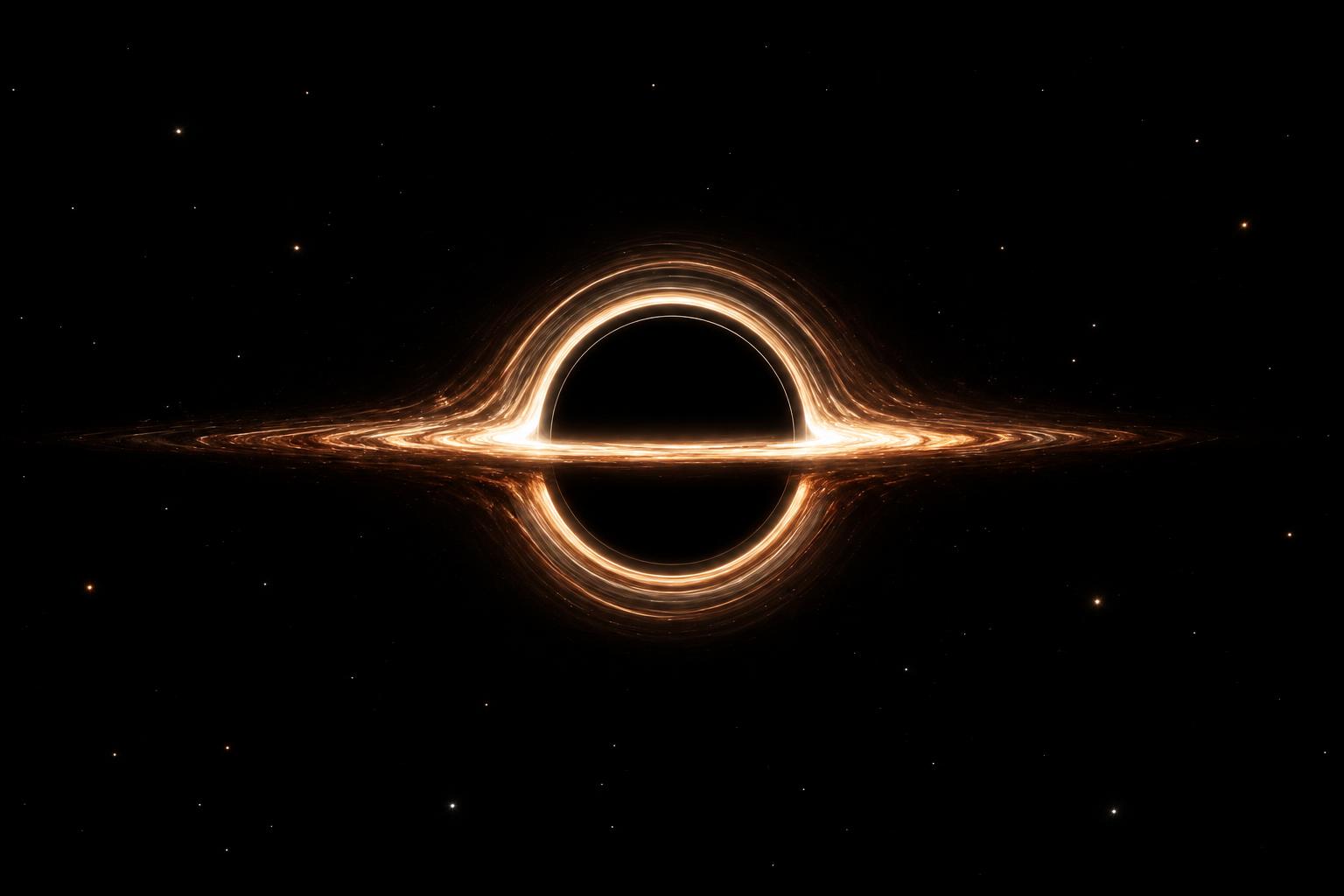
The event horizon is not a solid surface. It is the boundary beyond which no signal can return to a distant observer. The dark central region in this illustration represents the black hole’s shadow, which is larger than the horizon itself.
03When gravity bends light
Matter and energy curve spacetime. Light follows those curves, so the glowing disk’s far side can appear above and below the black hole. This effect is called gravitational lensing. The visualization is an artistic interpretation, not a live physics simulation.
04Time is not the same everywhere
Clocks closer to a massive object run more slowly compared with clocks farther away. Near a black hole, this gravitational time dilation becomes dramatic. A traveler still experiences their own time normally.
05How we study the invisible
Scientists observe hot gas, the motions of nearby stars, X-rays, and gravitational waves. The Event Horizon Telescope produced the first image of a black hole’s shadow in M87 in 2019. NASA observatories study black holes across the electromagnetic spectrum.
06The glowing accretion disk
A black hole itself emits no light from within its horizon. The glow comes from material outside it. Gas falling inward heats up as it forms an accretion disk, sometimes reaching millions of degrees.